I'm building Caffeine, a compiler written in Gleam that compiles service expectations to reliability artifacts. This post documents the motivation and design behind v5.0.0's move to explicit assume/guarantee contracts.
How We Got Here
Caffeine (v3.0.0 through v4.6.0) set out to improve the SLO development process: conforming to best practices automatically, reducing decisions through
typed inputs, enabling GitOps, and coupling documentation to code.
We accomplished all of that!
Then in v3.0.4 we introduced DependencyRelation, the ability to say expectation E1 has a hard or soft dependency on E2. This unlocked two things:
1. automatic generation of a Mermaid dependency diagram maintained alongside code
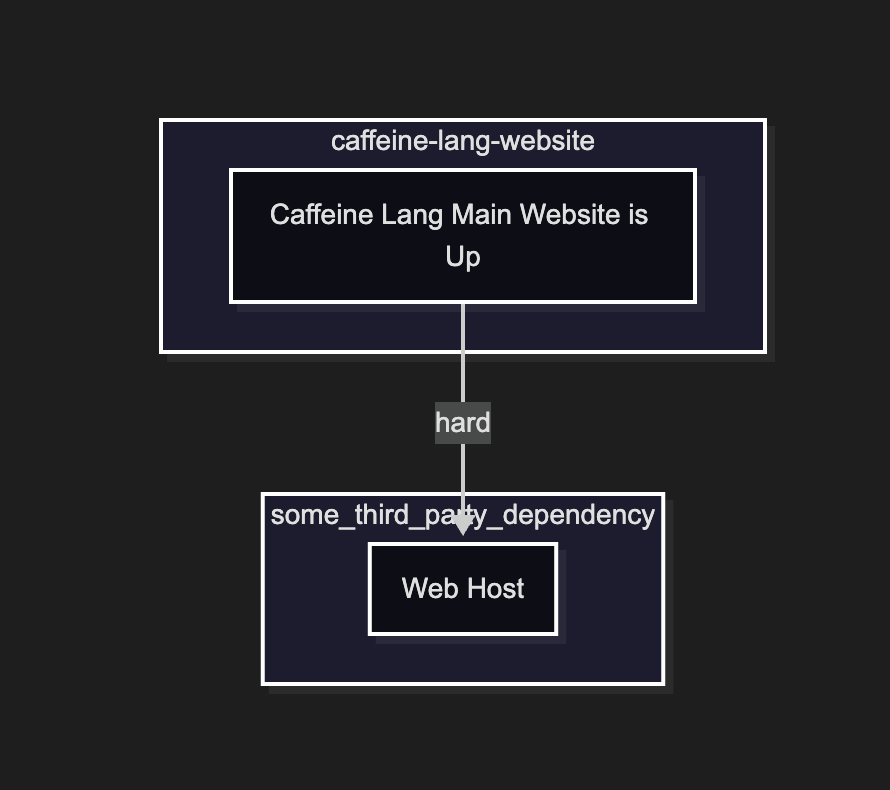
Exceptionally simple Mermaid dependency diagram with two expectations
2. compile-time enforcement of thresholds based on relationships: if you guarantee 99.5% uptime but hard-depend on something that only guarantees 99%,
the compiler catches it

Compilation error when we assert the website 99.99% depends on web host 99.95%
This was empowering. But as we iterated, it became clear that while this feature surfaced tacit information, it was theoretically incomplete. How can we make this relationship idea better?
It turns out we'd accidentally landed upon a well-researched area within formal methods: assume/guarantee contracts!
Jones, C.B. (1983). "Tentative Steps Toward a Development Method for Interfering Programs." ACM Transactions on Programming Languages and Systems, 5(4), 596–619. https://doi.org/10.1145/69575.69577
A key quote from the paper: "This paper shows certain problems can be tackled by a development method that is a fairly natural extension of that described in [18]. The basic idea is to add to a specification a precise statement of its interference: a "rely-condition" defines assumptions that can be made in program development; a "guarantee-condition" places requirements on the interference a would-be implementation can generate."
Fascinating! And yet not surprising. I don't believe anyone would argue most systemic guarantees are based on a set of implicit or explicit assumptions.
Caffeine v5.0.0: Assume/Guarantee Contracts
In formal methods, an assume/guarantee contract specifies a component's behavior in two parts: the assumptions it makes about its environment and the guarantees it provides given those assumptions hold. If a component's assumptions are violated, its guarantees are void. The idea traces back to Misra and Chandy (1981) and was formalized by Abadi and Lamport (1993). This compositional reasoning lets you verify systems piece-by-piece rather than all at once.
It turns out these ideas map cleanly onto what we were already doing. Specifying service expectations that manifest as SLOs is basically synonymous with guarantees. And the dependency relations we'd been building out? Those were surfacing assumptions, or the preconditions that must hold for a guarantee to be meaningful.
Once we'd realized this connection, the direction became clear. Instead of Caffeine becoming a tool with a grab bag of different artifacts, what makes the most sense is an assume/guarantee framework designed with the everyday developer in mind. Existing SLO tools like OpenSLO and Sloth let you define SLOs declaratively, but they treat each SLO in isolation: none of them validate that your SLOs are mathematically consistent with each other across dependency boundaries.
Specifically, this framework performs two system checks:
1. at compile time (or design time), it enforces all assume/guarantee relationships, ensuring they are at least mathematically possible
2. at runtime (or operation time), the generated SLOs signal in real-time whether the system continues operating in production as designed
To accomplish this, we need a set of fairly widely scoped changes:
1. dropping the idea of artifacts
2. making the assume/guarantee nature explicit and still consumable within the syntax
3. introducing expectation types to keep things composable
4. changing the semantics of blueprint from general abstraction layer to templated measurement definitions
Artifacts Be Gone
The original idea for artifacts was to generalize over the idea of things that someone responsible for the production operation for a system might need to
do their job. As stated above, we started with SLOs, then introduced DependencyRelations. Since the inception of Caffeine, many months ago, we have yet to
come up with really any other interesting artifact. Thus, in order to trade off some flexibility for simplicity, we're dropping the idea of artifacts and
homogenizing the three tier hierarchy (artifacts -> blueprints -> expectations) from the standpoint of the user.
Redefining Blueprints
With the above change to artifacts, it's less surprising to then change the semantics of blueprints as well. While blueprints did a wonderful job as the abstraction layer for SLO based expectations, (a) they only ever really made sense for SLO expectations, and (b) if you zoom out, it's clear they almost always were only scoped to defining the measurement part of the SLO artifact. Thus, while the transition from abstraction layer to a more well-scoped templated measurement definition might seem reductive, it's actually consistent with how these were used in practice.
Further changes include: organizing blueprint files per vendor (e.g. blueprints/datadog.caffeine, blueprints/honeycomb.caffeine) to make vendor scope
explicit, replacing the Provides block with a signals block that names the queries the blueprint uses, and Requiring in place of Requires (aligning with
the form extendables already use). Each blueprint also declares its expectation type and evaluation formula inline on the declaration line — for example,
success_rate(good / total) tells the compiler the expectation type is success_rate and that good and total correspond to the entries in the
signals block. Because this is real syntax rather than a string, the compiler and LSP can parse, validate, and offer completions for the formula.
_success_rate_blueprint success_rate(good / total) extends [_common] with:
  signals: [
    good: "some_query",
    total: "some_other_query"
  ]

_time_slice_blueprint time_slice(query per 5m) with:
  signals: [
    query: "some_query"
  ],
  Requiring: { otherFoo: String }
Notice that _success_rate_blueprint omits the Requiring block entirely — if a blueprint has no required parameters, the block can be left out.
Syntactically, some things stay the same and some change:
1. type aliases will continue to exist and be limited to blueprint files
2. extendables will continue to be scoped per file, but will now be limited to Requiring blocks only; today's Providing extendables (e.g.
_defaults (Providing): { vendor: "datadog" }) are being dropped since blueprints no longer have a Provides block
3. to leverage extendables, we will continue to support the extends syntax
Expectation Types
Before diving into the new syntax, it's worth understanding how expectation types work. They're foundational to making composition meaningful.
Internally, today's Caffeine already distinguishes between two SLO primitives (GoodOverTotal and TimeSlice in the CQL resolver). In v5.0.0, we promote
these to first-class, user-facing expectation types:
1. success_rate (currently GoodOverTotal within CQL)
2. time_slice (currently TimeSlice within CQL)
We specify the evaluation of these within the blueprint definitions via the inline type and formula syntax (e.g. success_rate(good / total)), and then
further indicate which type via the expectation's inline guarantee statement. success_rate is fairly straightforward: we treat each threshold as an uptime percentage and thus enforce
<= between the percentages (as we did before). For example, this would fail at compile time:
"Payment Processing":
  Assumes:
    hard dependency on "Database is up"
  Guarantees 99.99% over 10d window as measured by _success_rate_blueprint with:
    env: "production"
    baz: 0.5

"Database is up":
  Guarantees 99.9% over 10d window
Here, "Payment Processing" guarantees 99.99% but has a hard dependency on "Database is up" which only guarantees 99.9% — the composite availability
of the hard dependencies (the product of their thresholds, assuming independent failures) is lower than what the dependent claims to guarantee.
The time_slice type is more interesting. For this we (a) ensure the units are comparable and then (b) we normalize the units to enable comparison. For example:
"API is fast":
  Assumes:
    hard dependency on "Database is fast enough"
  Guarantees 99.5% below 50ms over 10d window as measured by _time_slice_blueprint with:
    otherFoo: "some_value"

"Database is fast enough":
  Guarantees 99.9% below 0.200s over 10d window
This would also fail. The dependency's latency threshold (0.2s or rather a normalized 200ms) is worse than the dependent's (50ms), meaning the assumption is unsatisfiable
under a synchronous call model. In practice, caching, async patterns, or circuit breakers can decouple a service's latency from its dependencies, but
the compiler treats a hard dependency declaration as a worst-case synchronous contract, which is a deliberately conservative check (and furthermore
if it does not make sense, folks can label the dependency as soft).
Formalizing expectation types is what makes composition meaningful — you can only compose expectations of the same type because the comparison semantics
differ (threshold <= for success_rate, latency normalization for time_slice). Structurally, this forms a typed DAG with monotonicity constraints:
expectation types are the partitions, dependency relations are the edges, and the compiler enforces that guarantees decrease monotonically along hard
dependency chains. If you squint, expectation types act as the objects in a small category where dependency relations are the arrows. Composition is then
only valid when the types align.
Assume/Guarantee Syntax
With expectation types established, let's look at how the syntax brings everything together. On the expectations side, the Provides block is gone entirely.
To see why this matters, compare the old and new syntax for the same expectation:
# v4.x — Expectations for "api_availability"
* "checkout_availability":
  Provides {
    env: "production",
    threshold: 99.95%,
    window_in_days: 30,
    relations: {
      hard: ["Database is up"],
      soft: []
    }
  }

# v5.0.0
"checkout_availability":
  Assumes:
    hard dependency on "Database is up"
  Guarantees 99.95% over 30d window as measured by _api_availability_blueprint with:
    env: "production"
The guarantee, assumptions, and measurement are now explicit in the syntax rather than buried as opaque fields. The with: block only supplies values for
the blueprint's Requiring fields — the signals defined in the blueprint are inherited as-is and are not the expectation's concern.
You'll also notice a new window syntax — over 10d window, below 100ms — replacing the raw numeric fields like window_in_days: 30 and
threshold: 99.95%. Today's CQL interval parser only supports seconds, minutes, and hours (s, m, h); v5.0.0 extends this to days (d), adds
milliseconds (ms) for latency thresholds, and introduces the inline threshold and latency syntax shown above. For clarity, the full set
of supported units is: ms (milliseconds), s (seconds), m (minutes), h (hours), and d (days).
Due to the nature of the complex distributed systems we model, there are varying levels of optionality within these definitions. The bare minimum is just a guarantee.
"Database is up":
  Guarantees 99.9% over 10d window
While this may seem meaningless, this represents something like an SLA for a dependency that you want to include within your system but you don't have any
way to measure it, nor does it rely on anything (to the best of your knowledge — it's a black box). Since there's no as measured by clause, no Terraform
SLO is generated — this is a design-time-only guarantee used for compile-time relationship validation. The compiler infers the expectation type from
context: if the guarantee includes a below latency clause it is treated as time_slice, otherwise it defaults to success_rate. This means a bare
guarantee like the one above is always success_rate and can only participate in dependency chains with other success_rate expectations.
From there, we might specify how to measure the expectation.
"Third party service is fast enough":
  Guarantees 99.9% below 100ms over 10d window as measured by _time_slice_blueprint with:
    otherFoo: "some_value"
Here we're measuring based on the _time_slice_blueprint blueprint which requires a parameter called otherFoo.
And finally, we can state assumptions. Assumptions are either hard or soft (like before). The key constraint: an expectation cannot guarantee more than its
hard dependencies allow. The compiler computes the composite availability from the product of all hard dependency thresholds — the standard formula
from The Calculus of Service Availability — and fails if the expectation's own guarantee exceeds it.
This assumes independent failures; correlated failures (e.g. shared infrastructure) can only make the real ceiling lower, so the check is conservative.
Note that soft dependencies are not validated at compile time — they appear in the generated dependency diagram but do not affect threshold checks.
This is intentional: a soft dependency means the service can degrade gracefully without it, so there is no mathematical constraint to enforce.
"Authentication Succeeds as Expected":
  Assumes:
    hard dependency on "Database is up"
    soft dependency on "Internal Queueing System Succeeds as Expected"
  Guarantees 99.5% over 10d window as measured by _success_rate_blueprint with:
    env: "production"
    baz: 0.5
The following is technically valid:
"Authentication Succeeds as Expected":
  Assumes:
    hard dependency on "Database is up"
    soft dependency on "Internal Queueing System Succeeds as Expected"
  Guarantees 99.5% over 10d window
However, it's a bit odd to have something with known dependencies but unmeasurable. This is still somewhat useful as it enables us to assert that the system design is sound at design time, just not at operation time.
What's Next
v5.0.0 is a significant rethink. The changes span the entire compilation pipeline: new tokens and grammar in the frontend, a restructured IR in the linker,
expanded validation in semantic analysis, and updated code generation. The LSP needs to learn the new syntax too — diagnostics, completion, hover, and
semantic tokens all need updating. And finally, we'll need to update all our documentation, including the language tour!
If you're interested in following along or contributing, the project is open source at github.com/Brickell-Research/caffeine_lang.